
Factory Feature: Outsourced Fashion Consulting, Los Angeles
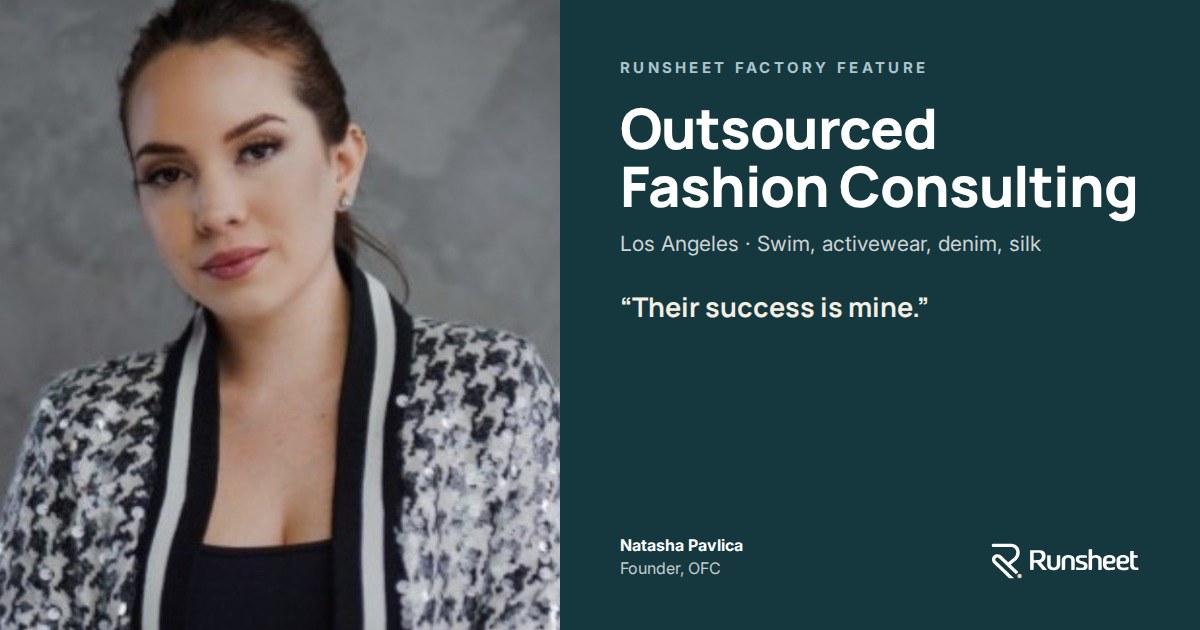
I've made my own clothing line, SÔZ Studios, with Outsourced Fashion Consulting (OFC) in downtown Los Angeles for the last few years. When I started Runsheet's factory features, Natasha Pavlica, OFC's founder, was the first person I wanted to talk to. This is for emerging designers about to make their first collection, and for established brands thinking about moving production to a new partner or bringing it back to the US.
How OFC started: two machines and no plan
OFC started in the middle of COVID, when very few factories in downtown LA were running. "I honestly wanted to do my own thing," Natasha says. "There wasn't really a plan set in place."
Her first client hired her for consulting and freelance work: managing production, some development and sampling. Word of mouth kept bringing more. Over time she saw that brands needed someone to actually develop and make their product more than they needed advice, especially established brands that already had a team and just needed another factory they could trust.
"I've always loved development and production. Having a business where I can do both is the best of both worlds: being creative, and being more business-oriented, which is the production side of things."
Natasha studied fashion design and business management at FIDM, then did a master's in business and marketing at UCLA. OFC started with two sewing machines. The floor now runs about 10 to 12: flatlock, overlock, single needle and coverstitch.
What OFC makes, and what it makes best
The range is wide: swim, activewear, kidswear, denim, tailoring, gowns, 100% silk, and recently leather. Denim in particular is picking up domestically.
Ask what OFC does best, though, and the answer is quick: activewear and swim. "The people operating the machines that make swim and active are really good and really experienced." They recently finished a run of tennis dresses: "I myself was personally shocked at how good it looks and how elevated it looks."
Swim and activewear are also some of the hardest categories to sew well, and she explained why:
- Specialty machines. Flatlock and coverstitch have to be set exactly for the fabric.
- Thread and tension. Elastic thread, poly thread and cotton thread all behave differently, and the machine tension has to match.
- Re-dialing. On one run of capris and sports bras, the team readjusted the machines about four times before the garments were right.
"Compared to active and swim, denim is easy."
The other thing she's proud of is how her team switches between fabrics. In a typical four-to-six-week production window, OFC might be sewing three to five fabrications at once: swim, silk and denim side by side. "Moving from silk to denim to activewear and still making it look really good. I'm impressed with their abilities."
Much of the sewing and cutting team has been with Natasha since before OFC existed. "It's really hard to find good sewers, or to train them so the quality meets your standards." The office has grown (coordinators, marketing, social media), but the production team is the core she's kept.
Why she won't send you to another factory
Plenty of factories pass work they can't take to someone down the street. Natasha doesn't.
"I don't like to send my clients somewhere else, because I don't have control over that other factory or the mistakes that could happen. My reputation is OFC, and I take that very seriously." If OFC is full, she'd rather queue the project: "We can queue it in a month, a month and a half. I usually accommodate."
That also shows up in how she works with small brands. When I've needed two mediums pulled mid-production for a buyer meeting, the answer was yes. "Brands that are worth millions of dollars are more structured. Smaller brands need 'Can you pull one in each size for a photo shoot?' or 'one in each color for a buyer?' I understand how much it takes to start a brand. Their success is mine. Even if they eventually move on to another factory, as long as they're succeeding, I'm happy."
From first call to production: how a project runs
Here's OFC's process, start to finish:
- First call. You share a reference image, or a tech pack if you have one.
- Quote. OFC prices the services you need.
- Service agreement. Once the quote is approved, you sign one. Its main job is protecting your tech packs, patterns and IP: "We don't share those with anybody else."
- Sourcing and development (about three months). It opens with a sourcing meeting covering fabrics, trims, labels and hang tags, and ends when the second fit sample is delivered.
- Production. Minimums start around 50 units, and the floor can turn out roughly 1,000 units a week.
Two fit samples per style is the sweet spot Natasha has landed on. A complicated style gets another round. Since OFC started using 3D renderings, development has gotten shorter: "3D renderings cut at least one round of samples."
I saw that firsthand on a very technical posture-correction top we developed together. The 3D render flagged pinching under the arm before anything was sewn. That project still went to three or four rounds, but not because sample two missed. We kept finding ways to make it better. "It's kind of an addictive cycle," Natasha says, "because you want to get to perfection. Sometimes you have to learn how to stop yourself."
Do you need a tech pack to start? No. "As long as there's some sort of image somewhere, a sketch, a photo, something, that's enough for us to put together a quote." If you're still deciding what to make, OFC can run a design meeting during development. If you want a head start anyway, Runsheet's free tech pack generator gives you a first draft to bring to that first call. It won't replace measuring a real garment, but it makes the conversation smoother.
What she wishes brands knew before reaching out
Without hesitating: a realistic budget for domestic development and production.
"I've had clients come to me saying, 'I want to develop and produce five different styles, a hundred of each, and my budget is $3K.' That is just not realistic for domestic." The gap usually comes from not knowing how different wages are between overseas factories and the United States, especially Los Angeles. "As much as a factory wants to help you and make it work, 3K is not enough to develop and produce five styles."
Before you reach out, run your numbers through Runsheet's free small-batch cost calculator. Then you'll show up with a budget a factory can actually quote against.
Domestic or overseas?
Neither is better. It depends on what your brand needs, and Natasha says so plainly: "Overseas is amazing. Domestic is amazing. It's just what's important for the client. Do you want more control, a more one-on-one, personalized service? Domestic is the way to go, and that comes at a cost. If pricing is the only thing you care about, overseas is your bucket."
For my brand, making in LA meant faster turnaround, quality control I could see for myself, and nothing stuck on a boat in Long Beach. I could visit the floor, pick up samples the same day and shake Natasha's hand. Those things cost more, and I knew that going in.
She also pointed out how fast things move: last year, with tariffs at their peak, a lot of brands rushed to domestic production. This year that has slowed as tariffs came down. And even domestic production often relies on imported fabric: "The US doesn't have the capacity, the machinery or the labor to make some of these fabrics."
If you're weighing the two, Runsheet's free domestic vs. overseas tool walks through the trade-offs for your specific product.
How she keeps brands in the loop
Natasha's rule: a client shouldn't go more than three or four days without hearing from her, even when there's no news. "Even if there's no update, I'll send them an email."
She also still takes every call herself. OFC has no project managers between you and the owner. "Other clients have told me they like that they can talk to me directly. There's no 'she said, he said.' I love having a relationship with my clients and troubleshooting with them." She tried hiring a project manager once. "That's not happening anytime soon."
That's what sold me on OFC in the first place. Some of the other factories I talked to back then took a long time to get back to me. On OFC's first call, the owner made time to answer every question I had.
Takeaways for emerging brands
- Bring a realistic budget. Domestic development and production cost more because LA wages are higher. Price it out before the first call.
- You don't need a finished tech pack. A sketch or reference photo is enough to get a quote.
- Plan on about three months of development and two fit samples per style, more for technical garments.
- Choose domestic or overseas on purpose. Weigh control, speed and communication against unit cost.
- Work with people who will tell you the truth about your budget, your timeline and your garment.
Work with Outsourced Fashion Consulting
OFC is a verified factory on Runsheet: see their listing, or request an introduction to start that first conversation. "We're here. We're happy to help," Natasha says. "Intro conversations, discussing your project, whatever people need."
Worked with OFC? Leave them a review.
Interview answers lightly edited for length and clarity.
See their capabilities, minimums and reviews, or ask for an introduction and Runsheet will connect you.
Request an intro →See their profileSearch 13,358+ apparel factories, or post a brief and let the right ones come to you. Free for brands.
Search factories →Post a brief